

In the webinar held on July 24, 2025, two startups provided insights into two trending topics related to the use of artificial intelligence in everyday office life: smart knowledge management and AI agents. These two approaches overlap in some ways and address key challenges in the modern workplace—from the efficient use of internal knowledge to the tangible relief provided by automated assistance systems.
Knowledge That Thinks for Itself
In the first presentation, Armin Zoike from complemental.ai demonstrated how companies and organizations can use AI not only to make existing knowledge more easily accessible in a structured way, but also to tap into previously untapped knowledge. The background: About 80% of relevant knowledge is hidden in people’s minds and isn’t systematically documented. Employees spend 20–30% of their time searching for information or reworking tasks that have already been completed.
complemental.ai has developed a solution for this that contacts the right people when data is missing and makes it easy to share missing knowledge via chat, images, or short comments. This creates a growing knowledge network that isn’t limited to existing databases.
Language agents that take the pressure off customer service
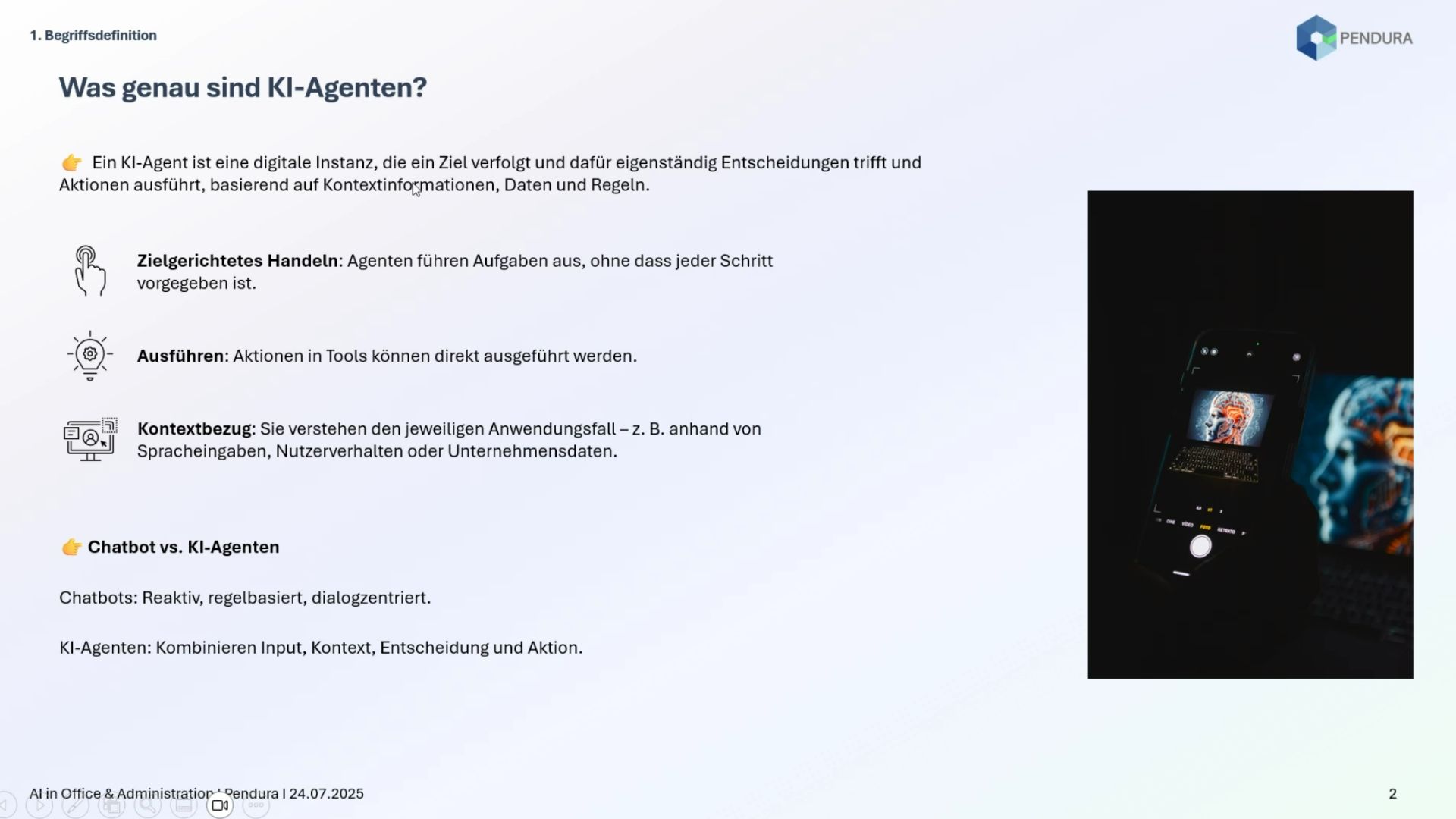
In the second part, Oliver Wittig from Pendura presented the practical use of AI agents in everyday office life. Unlike traditional chatbots, these systems operate actively, autonomously, and contextually—for example, as a voice agent on the phone that automatically takes customer inquiries, answers them, and triggers follow-up actions.
A live demonstration showed just how smoothly a phone call with such an AI voice agent can already proceed. The best part: Such agents can be implemented with minimal effort and without extensive IT intervention—the first prototypes are ready for use in just a few days.
The webinar made it clear that modern AI systems not only respond to existing data but can also actively acquire, link, and meaningfully apply knowledge—whether through voice input, within a team, or across departments. Both intelligent knowledge management and AI agents offer significant potential for efficiency gains—especially for companies struggling with a shortage of skilled workers, an information overload, or internal knowledge silos.