

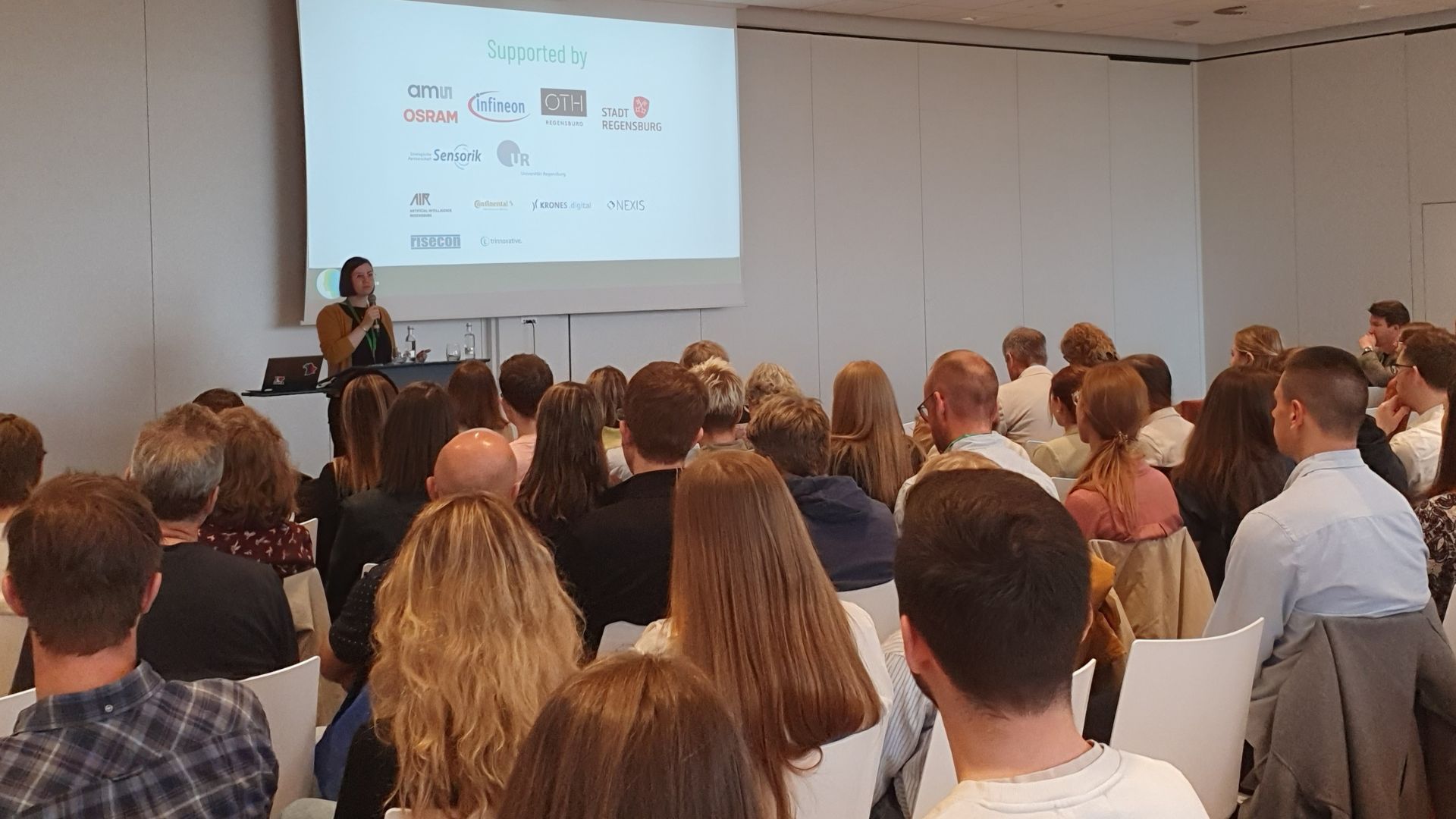
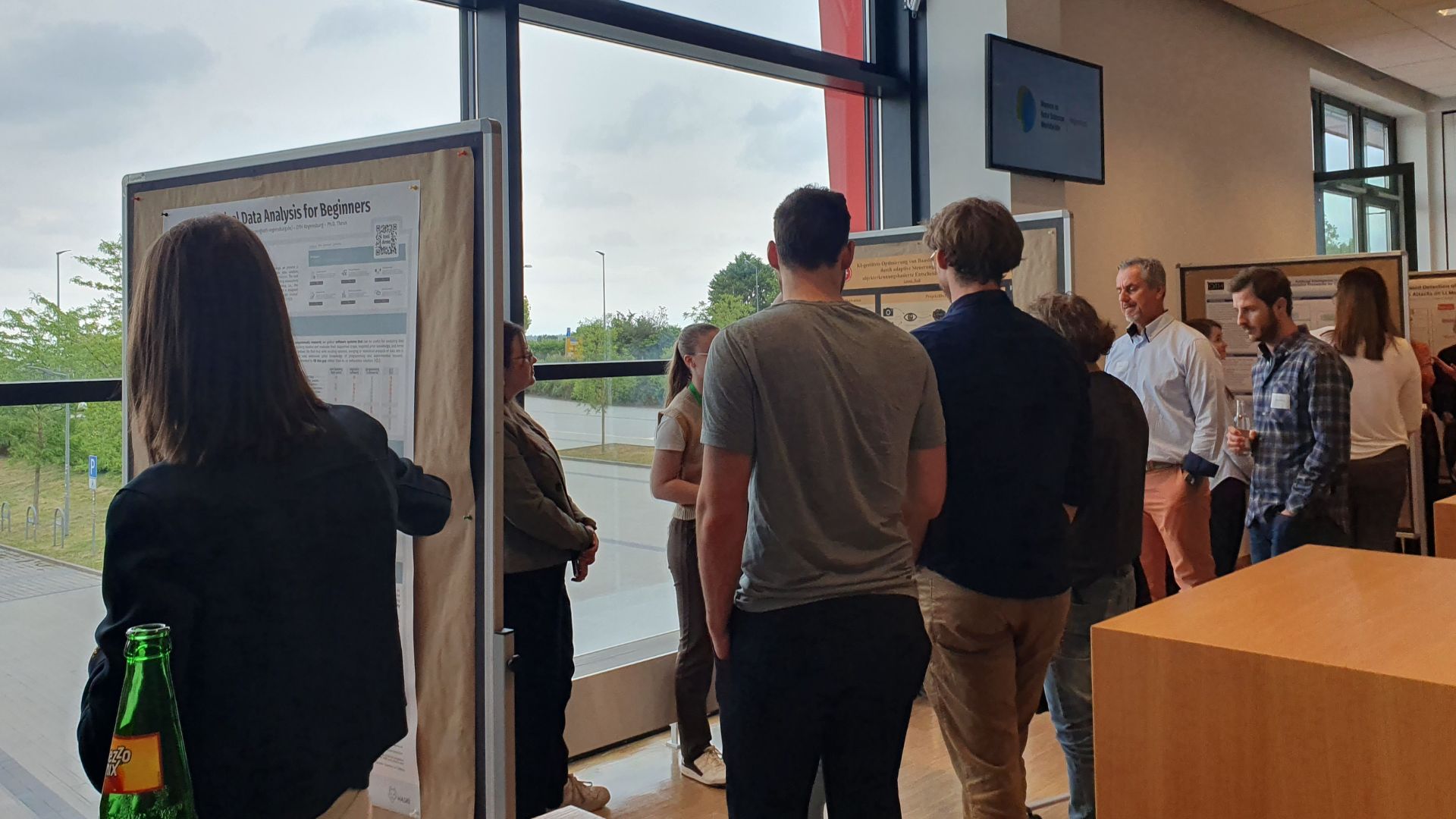
A wealth of data science expertise presented to a packed audience in the Jahnstadion conference hall—and during the “halftime break,” a focused showcase of regional research featuring 15 poster presentations. On May 22, experts and emerging talent from academia and industry gathered for the fifth edition of Women in Data Science Regensburg (WiDS). With around 160 participants, the event was fully booked—a clear sign of the growing interest in data science, diversity, and innovation. On the agenda: AI for power grids, explainable algorithms in medicine, causal models in industry, and data ethics concepts for government practice.
WiDS Regensburg has become more than just a professional conference—it is a statement in support of diversity in MINT professions and a driving force for networking within the data science community in Regensburg, the region, and beyond. The fact that all presentations were delivered by women underscores the event’s commitment to highlighting role models and fostering new talent. Behind the conference is a team drawn from academia, industry, and regional networks. As part of Stanford University’s global “Women in Data Science” initiative, the event is dedicated to one goal: making data literacy accessible to a broad audience—in an interdisciplinary, practical, and diverse manner.
Energy, Medicine, Industry: Data Competence as the Key
Using data to address regulatory and real-world challenges—that was the focus of Dr. Sarah Henni’s (E.ON Digital Technology) presentation. Her team uses data and AI to manage uncertainties in smart power grids during the energy transition. Of particular relevance: the interface between high-voltage logistics and low-voltage consumption—and the close collaboration between data scientists and on-site grid operators. Dr. Kata Vuk (University of Regensburg) focused on explainable AI in a medical context. She demonstrated that model accuracy alone is not enough—interpretability is crucial, especially in medical research. Her presentation made it clear that anyone making data-driven statements in medicine must draw the right conclusions—and be able to communicate them in a transparent and responsible manner.
Causality as a fundamental prerequisite for robust decision-making—Dr. Kaja Balzereit (Hochschule Bielefeld) explored this aspect using cyber-physical production systems as an example. She demonstrated how modern machine learning methods gain depth through systemic thinking and causal models. Data alone does not make a difference—it must be used and interpreted correctly. A look at police work in practice concluded the lecture program. The application scenarios presented illustrated how AI applications can support professional investigative work. However, this requires embedding them within a comprehensive data ethics framework that incorporates a sense of responsibility.
No shortage of scientific curiosity in the region—extensive poster session
In addition to the technical presentations, the poster session was a particular highlight: Students, researchers, and professionals from various companies presented around 15 projects and engaged directly with the audience. The diversity of the submitted posters reflected the enormous breadth of the data science community and demonstrated that Women in Data Science Regensburg is a vibrant forum for new ideas, critical questions, and new collaborations.
About the “Women in Data Science” team in Regensburg:
WiDS Regensburg is organized by a team of early-career researchers and representatives from companies and universities. It is supported by Regensburg’s universities, the City of Regensburg, and the Strategic Partnership for Sensor Technology e.V. (the sponsoring association of the Bavarian Cluster Sensorik). As cooperation partners, regional companies make it possible to hold the conference free of charge.